Shireen Garrison
Hi, everybody. Welcome to Smart Supply Chain, a podcast for supply chain professionals who think and work smarter. I’m your host, Shireen Garrison, along with my sister in supply chain, Sarah Garrison. Hi, Sarah.
Sarah Garrison
Hello Shireen, Welcome to the show everybody.
Shireen
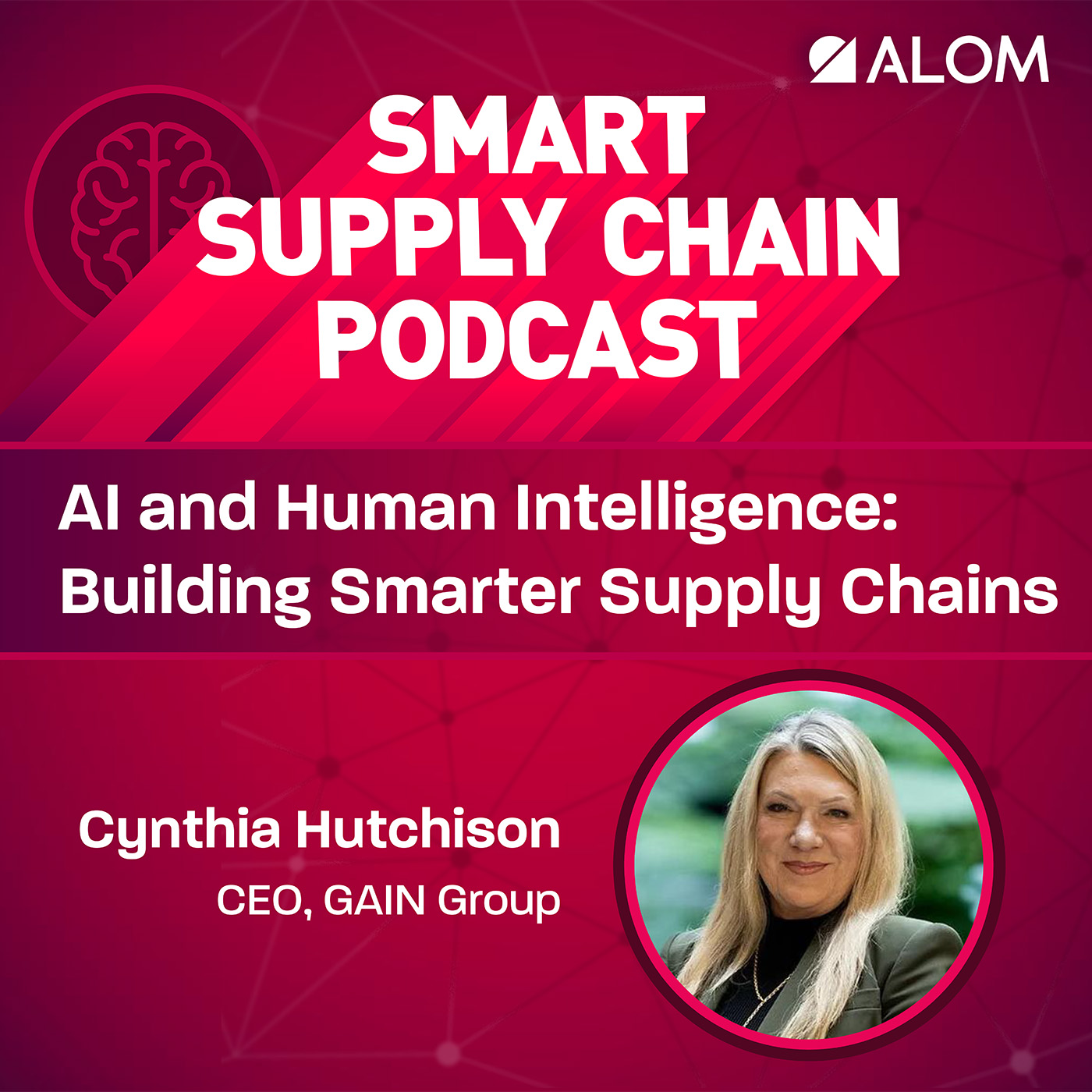
Today we are going to talk about manufacturing, end to end supply chain and the importance of connections. Our guest today is Cynthia Hutchison and she brings decades of experience to advanced manufacturing and industry transformation. She’s held leadership roles at the US Center for Advanced Manufacturing and Automation Alley. She’s worked closely with the World Economic Forum as well. Cynthia has spent her career connecting with people that make things so people like manufacturers, government people and researchers. And those people generally don’t end up in the same room together. But Cynthia’s going to tell us about how she does that. And her current focus now is the founder and CEO of the Gain Group. Cynthia, welcome to the show.
Cynthia Hutchison
Thank you, Shireen. Nice to be here. Nice to see you, Sarah. Good to be with all of you.
Shireen
It’s great to have you here. I want to start from the beginning and just understand a little bit more about your background, because I understand that you actually went to school for English and communications, but somehow you’ve ended up in operations and manufacturing. I’m curious how you got there and what interested you about this field.
Cynthia
You know, I often think back to the time and my father passed away about 3 years ago, so I know he really regretted as a young woman that didn’t go into engineering because I was naturally very analytical, very strategic, very spatial oriented. And he was an engineer and was so excited that I was recruited by all these cool schools to go into engineering. And I was a philosophical kind of purist about education. And I should be learning something that I need more skill in. And that seemed to be the creative side. So, I went ahead and did writing and explored more the creative side of life. However, that curiosity that drives process, I think has always been embedded in me. And after we first talked, I thought about this a little bit. I did. I grew up in Pittsburgh. And in Pittsburgh there when I was growing up, steel mills were still running.
So being in manufacturing, being a part of a process that created things was a tremendous amount of pride. You know, my friends will talk about their dads at the time, they were not often their moms to the factories, but their dads made part of a car, made part of a Caterpillar or truck, made part of something that people recognized and knew. And I think that’s probably what really stimulated me to understanding that everything we see, wear, drive has been made by somebody. And I feel like over the years I have been asked many times to make manufacturing sexy again. And I can’t do that because I don’t think it ever was. I think manufacturing has always been hard work. It’s very serious work. It’s very critical work.
And again, I’m, I’m from Detroit now. We make things that people take their baby home from the hospital in. Nobody takes that lightly. So we can’t have, and I, I don’t mean to pick on the phone, but we can’t do this and say, oh, just turn it in, I’ll get you a new one, because, you know, we make things, people take their babies home in. So in the US in general, the manufacturing we’ve done, it’s really important we get it right, get it right the first time. You all know in supply chain what horrific consequences there are when there’s a recall that ends up, you know, implementing an entire new structure. So that’s part of it, I think is always understanding that what made manufacturing great wasn’t being sexy. It wasn’t the coolest game in town. It paid well, it was extremely noble and respected. And when you lose either of those, I think that’s when you begin to fracture and it’s harder to draw people into this field. I’ve been drawn into it because I think it’s, it’s kind of a backwards approach.
I have a son with Down syndrome. When he was born in 1989, I was working in technology. I took time away from that, and I started working to find out why people with disabilities weren’t a part of the supply chain, weren’t a part of the educational system, weren’t part of the workforce. And as I learned that and built programs to solve that and make it better, I accidentally became a supply chain professional. It was only after doing that for quite a few years, you know, by the way you introduced me, the decades and the decades thing I know, but you know, it starts to make you sound a little bit a little bit older. But I did spend 20 years doing working with people with disabilities and advocating.
And in that I learned the process that I think is what I use to this day, which is still a left to right, left to right manufacturing workflow that has to happen for any project to be successful.
Shireen
You obviously have a creative side as well. How do you bring the creative artistic stuff into your life? Is that go into your professional life or you keep that in your personal life?
Cynthia
Now it actually does go into my professional life and harkening back to when Jordan was born and I started doing advocacy, I really, that’s the first time I realized how much the right people aren’t in the room together.
And that was a creative thing. It’s very creative, by the way, to get Cadillac to become the sponsor of your first fundraiser. So I had a fundraiser, it was a $250-a-plate dinner 25 years ago. And I asked Cadillac to sponsor. And when the gentleman initially when I approached him, somebody I knew and he was the general manager of the division and he said, oh, you know, I’ll talk to my colleague at Chevy. And I had like that mother reaction of, I’m sorry, so Chevy is a better fit for my son. But is Cadillac a fit for your son? And after that conversation, it became clear to me that even the most capable, brilliant executive with a lot of responsibilities doesn’t always know how to put the right pieces together. So I wrote him his intro. I wrote the intro that talked about why all people have a right to aspire to be a Cadillac. By the way, if you all don’t like Cadillacs, and if you’re all, you know German sports car driver, that’s fine too. In, in my context that worked.
But when you talk about that, you’re, you really need to look at the strategic implications and why you put different people together. So once you put Cadillac in the same room as people with disabilities, in the same room as educators, in the same room as companies who are hiring a lot of people in a supply chain, they start to see capabilities in one another, not just people with disabilities, capabilities from the marketing department, how the marketing really drives the sales, how sales really drives finance and how finance drives operations. And those pieces I think require creativity when you’re bringing small businesses into a room with large businesses. Supply chain, we hear it all the time that our small to mid-sized supply chain doesn’t get enough opportunities. I don’t think we can sit back and wait for that to happen. I think we need to talk to senior procurement officers at major companies and say, I want to talk to you very strategically about how you’re going to get the small supply chain into your into your building. And when you do that, how are you going to facilitate a company that doesn’t have a supply chain officer to being successful with you? So, there’s a lot of creative thinking that’s required to execute what sounds on the surface like repetitive work.
Sarah
I love the Cadillac story and I’d love to read the introduction that you wrote for him. But let’s talk a little bit about the Gain Group. I understand that this is a consulting group, which I’m sure is very integral for a lot of making things be successful. But tell me, how is Gain Group different than sort of your traditional consulting group?
Cynthia
It’s, it’s a very boutiquey firm. And I, I made the decision that, well, first of all, I want to run a small company. I’m really excited about having a small business after many years of not having a small business. And I like that. But I think what it is we really don’t have a product to sell. You know, we, we have no allegiance or any specific partners. We have a deep sense of trying to bring the leaders of industry together to get to know one another in ways they perhaps wouldn’t otherwise. And I don’t want to be redundant, but I do think academic research is required. Honestly, policymakers are required in order for us to move supply chain. I look at some of the things that are happening with defense right now to move supply chain down the road. We have got to be talking. The same people who make the parts need to be in the room with the people who make the policy.
They don’t need to live with them. They don’t need to be there all the time, but we need a quarterly meeting where those voices are heard. And again, it can’t just be the top 10 primes in the country or the top 10 OEMs in the country. Needs to be the supply chain and hear how that one little change you’re going to make at a very high level that a large company could can absorb will quickly filter into a pit of sand if a small business has to comply with all those regulations. So I think putting those same people in the room is critical. So that’s one of the things that Gain is doing.
We’re also working with some startup companies, which is different in in manufacturing as a strategic advisor to a product pricing for pitch competitions for how to prepare their pitch, what it might, what might land, what might not. That’s been an exciting part for me and I have always liked the excitement of putting small to mid-sized businesses in the same room as large businesses. And the only thing more fun than that is throwing innovation in because the innovators make everybody think differently. And I think that’s something that helps Gain glue it together.
So strategic advice, thought leadership, I don’t know very many people who run companies who don’t have great thought leadership. Unfortunately, you know very few who articulate that well. And a lot of us aren’t all that overly proud and we feel braggadocious if we start talking about what we do. So it’s sometimes good to have a third party, take a look and say, oh, I see you have the following strengths. Let me document them and help you tell your story. So that’s a part of what we’re doing. That’s kind of unique, I think.
Sarah
Well, tell us, how do you go about bringing in that innovator into the conversation? Who is that?
Cynthia
You know, I have been very fortunate in, in a lot of things. You know, the roles that I’ve had have been very different. I got pretty comfortable talking to media again, all the way back to my nonprofit years. I talked to media and I also learned from that, that media is if you, if you look at media as me being on camera, that’s not good media. If you look at media as getting a story told in a way that lots of people will understand it and people start to tell their friends about it, that’s when media becomes valuable. Along the same lines, when you work for a company like the Fellowship I did a few years ago with the World Economic Forum, that’s a media presence in and of itself.
So when you sit and swirl in that world, I still have tremendous clients from those days because it was great work when I when I went to Geneva for that part of the fellowship, I oversaw 13 nations’ advanced manufacturing centers that were a new program rolling out of the World Economic Forum. I’m still in contact with all thirteen of those countries and they’re in in ironically, they’re policymakers, they’re academic leaders and they’re major businesses. So the piece that I do today that I bring to Gain that is relatively unique is still coming from some of those people.
I’m working with an AI company out that I met through Turkey. They now have a US branch. I’m working with a manufacturing it’s an unusual part, a rust corrosive part that goes on that goes on cars, washing machines, submarines and that company came out of initially Korea. So I have those contacts that then now have a US office so that I can get more involved in the US manufacturing. But I’m guiding them through the US ecosystem, and I work in collaboration with a lot of people who are smarter about bringing people to the US than me, smarter about how to accelerate a product. I’ve got colleagues that help me who work specifically in economic development and some that work specifically in government affairs, and somebody who works specifically in startups. So I’m able to bring those pieces together.
Shireen
So you brought up AI, Cynthia, and that is in every conversation I feel like I’ve had over the past several years. I’m wondering how you’re actually seeing it used in manufacturing and supply chain and what do you think is going to be happening right now and in the future? Is it, is it hype? Is it helping? Like what are you seeing when you’re talking to these different companies?
Cynthia
I think there’s an abundance of hype. I think there’s abundance of brilliant work coming out of AI, think AI is exceedingly useful. There’s also particularly in supply chain. And I’ve seen something as fundamental as this. I work closely with a company out of the, you know, out in the Pacific area that has 100 and it’s a big supply chain company and they put together 150,000 US manufacturers, particularly for defense and any kind of US only initiative. They’ve got a great database. They know a lot about them. They’ve met them, they’ve sat with them, they’ve seen their factories or they’ve had these video tours of the factories. They know what they’re making and I thought when I first met them, way more importantly, what they are capable of making because that you’ve made something. I’ll go back to defense since it’s such a unique industry that you’ve made something for a John Deere tractor doesn’t mean you can’t make it for defense. It means you’ve only made it for John Deere up until now. I’m not, I just like John Deere. I like saying John, I like I like things that I can think of like Whirlpool, John Deere, Ford, you know, your grandmother knows what those mean like they’re powerful brands. Yes, you can you get the color coding all of it. But when I think about that, it takes a lot to make all of that work. So when you get to know capabilities versus what you’ve already made, you’ve really expanded the world.
So now I know how many machines you have, what your tolerances are, what your porosity is, whatever components is rescue, you give that to me and I can go into that database and find that provider for you. One of the things I’ve talked to the CEO of that data, that company, and he has shared with me that sometimes people want to learn about what he does and that’s it. I’ll just Google it, OK, or I’ll use AI. AI can tell you what they’ve done. The predictions of what they can do is the piece that requires you. We talk about the marriage of AI and human intelligence. That’s a part of it is how do we marry these two together? And we first have to know where we’re limited. But I’ve done the exact same thing. I look up, I look up things using, I love AI, but I use AI and you get great responses, mediocre responses, sloppy responses, responses that aren’t really at all what you were looking for. So one of the things I think we’re at a really early stage of AI yet where we’re learning, you know, I hear all the time about, you know, prompt, but it’s more than more of an in depth prompt. Once we start looking for something using AI, what is it you really want and how do you keep digging further? So I think the hype is the hype is temporary. I think as more people get proficient, it will get better. I also think we’re probably going to have some tools developed that will make it better because there is a layer in there of.
And again, I just talked with the CEO recently who had hired people right out of really high end colleges with great credentials and told me that what was produced for her was consistently mediocre. And, and she said it’s not. And she said it’s not their fault, it’s my fault as the, as the person who hired them to not say you need to keep asking yourself questions. You need to keep asking second question or third question, validate your own question. So I think having AI for supply chain, it doesn’t mean that you’re going to get, if AI could build an entire supply chain in a day, we would have done that. AI can find a lot of suppliers who could probably make this this. But if this is made by this, how do we manufacture the next level up or down? And I think that’s where we get into struggles with it. So yes, I think AI is extremely exciting. I think that’s a fabulous resource. I think that particularly I couldn’t, I still worry about the small to mid-sized manufacturers because if you’ve ever been in a factory with 100 employees, they’re all working, they’re all running the equipment to make the thing that we’re all going to eat, you know, drive, walk around in. And there’s rarely a payroll position in a company that size for somebody to go learn how to do it better. And there may be challenges, there may be opportunities for people to compete and try to get better, but it’s not really on the 9:00 to 5:00 or 8:00 to 4:00 time slot. It tends to be something extra.
So my concern is that without some type of support and intervention, our small to mid-sized providers will fall further and further behind because we’re not going to get the time or capacity to really learn the tool to make it good. What I don’t want to see is small to mid-sized suppliers submitting things that look kind of mediocre.
Shireen
Yeah, you really need the space and the time to understand. You gave an example when we were talking previously about how you really use AI to challenge your thinking and really put in, you know, don’t let you think that you have the answer kind of sorted already in your head and use it to challenge. Can you just talk about that a little bit?
Cynthia
Yeah, that’s what’s one of my, you know, I, my preference is Claude. But when I talk to Claude, I always say, please take a look at this, come back at me, challenge what I’ve said. This is my premise. This is how I understand it. If I’m wrong, redirect me and I get great feedback from that. I also get, you know, interesting sometimes when I’m not even asking it for. I know now Claude is very feel feels very empowered to criticize me on a regular basis, but that’s OK. So I would periodically get responses back. They’re telling me that have I thought it through from the perspective of XYZ? So those kinds of things are interesting because that’s where AI is more powerful.
Also, I may have told this before, I see people use AI as like high end Google and it’s not high end Google. It’s really so much more than that. But I think there were probably, I don’t even know the percentage of people who use it as high end Google. You know, Google was a little more depth to it as opposed to and again, that’s another left to right structural thing. This is a tool we’re going to frame out. We’re going to frame out a vision. We’re going to look at our strategic goals. We’re going to map out a timeline. We’re going to feed that into AI. And AI is going to say, I don’t know how you’re going to possibly get the airplane built, Cynthia, in less than 18 months because you don’t have your part, your partners lined up yet. Then you go back and say wait a second and you resequence what you do. But I think. I look at supply chain executives and think this may be a great opportunity for them to re. . . . You need to let go of ego and resequence the way things have been done on a really, you know, close to home view of it.
I look around at things like building a house, putting on an addition. I don’t know that any one part of it is it’s all very hard for me, but you know, a good contractor can, they can all, I don’t know the sequence, the sequence of when you, when you dig the lines for the plumbing, when do you, you know, the plumbing, the electrical, all of those pieces come together. Somebody knows how to do that. But even that industry is going to be deeply disrupted because somebody is now going to not require a scheduler to put it together. It’s going to be an AI streamline that if you’re in an XYZ area, this is the date you do this. You have 30 days to get to that. I think those kinds of timelines that we see on a very superficial level in some building a house are very deeply embedded in the US supply chain that you both know better than I do. It really like the depth of what we have to do with US supply chains. We really need to look differently from how we’ve been doing it for all these years.
Shireen
I do think it’s good to challenge the way that you think about things being done the way they’ve always been done and like pushing forward along with obviously you need some human oversight in that as well to think about whether or not that really works. But those are some great suggestions.
Now we’re going to take a quick break. Thank you so much for tuning in to our Smart Supply Chain podcast. This podcast is for supply chain professionals who think and work smarter. We hope that you’re enjoying the conversation so far. If you are enjoying the insights, we encourage you to visit alom.com. That’s A-L-O-M.com for more resources such as additional podcasts, blogs, white papers and more. If you find value in our podcast, you can follow us or reach out on LinkedIn or on the website and let us know what you’d like to hear about next. Now let’s get back to our discussion with Cynthia Hutchison.
And we’re just diving into the topic of the future of supply chain and manufacturing. Sarah, take it away.
Sarah
Yeah. So AI is obviously going to be disruptive no matter what the outcome is with where, how it impacts manufacturing and supply chain companies. It’s going to be a disruptive event. When we’ve had a recent disruptive event in COVID. Do you think, are you seeing that there are things that companies learned, that they are sort of taking those lessons learned and changing how they’re moving forward? And are there things that people maybe learned in the short term and now are forgetting as we get further away from that disruption?
Cynthia
I hope, Sarah, that that people write in to you and tell you that woman was wrong. But I’m about to say something, right. Post, maybe 2 years post COVID, a year and a half post COVID, we did a supply chain event with GE Healthcare. They were fabulous. And the chief procurement officer, GE Healthcare, I asked her to bring 2 to 3 downstream supply chain people. So, she brought 3 downstream supply chain people. We talked, and nobody wants to talk about COVID once we’re out of it, but I said we have to talk about how did you go? How did you become exponential in your productivity of making, you know, the ventilators and they were huge. They saved lives. How did you do that so quickly? And the conversation was fascinating because it was about things as simple as a vendor. And at a tier one level, the vendor had a certain threshold for purchasing power. And obviously that scales down. There were tier 3 suppliers who could not get a loan for more than $2,000,000 and suddenly they needed $10 million worth of equipment just to fulfill the order upstream. So, GE Healthcare, their supply, they were, they went to the banks for each other. They cosigned, they gave advance notices of purchase orders. Those kinds of things changed the way and they moved it like this. Everything got done so quickly because it was life and death. And I remember leaving that session and saying, do I need to tell all of you was a supply chain session? Do I need to tell you all that there’s an emergency or can we assume that manufacturing in the US is an emergency and we can all work at that same excited, almost adrenaline rush, like let’s find a way. And I don’t know, I, I feel like it lasted. It was a curve that kind of fell back down. It kind of lasted a while and then it got sort of complacent to all we’ve got these people we always deal with. And this is the way we’ve always done and this is our, our process. So I think unfortunately I I’m not sure that we’re ready. I hope we aren’t faced with one. I’m not sure that we’re ready for a crisis because I don’t know if we’ve learned quite enough to really make it better.
Sarah
So thinking about what’s ahead then I mean, we’ve got a lot of disruptions that are happening right now. We’ve got AI that’s going to layer in on top of all this. If you’re looking forward, what are those things that in addition to that urgency and speed that companies need to be thinking about implementing and practicing to be successful?
Cynthia
All right, when I think about it, and we really have a great depth of product development and, and you know, I look at how supply chain works, really close to nothing is made in a single country anymore. You know, our washing machines, our cars, our phones, our TVs and the global genie can’t be put back in the bottle. We have a global economy. So with understanding we will always have some geopolitical disruption. One year will be, you know, it just doesn’t matter. There’s always going to be geopolitical disruption. There’s always going to be some kind of climate disruption. It’s how you plan for that and your your plan A, plan B, plan C, your strategic. I may have told you this earlier. I started my career in technology and one of the things we do is every building that had, you know, back then, phone service coming into a data. It was the data that had to have two routes in the building. It was just a natural thing to have that, you know, diversity. I think we need to get more diverse as we have all this complex machinery. And as much as we talk about American manufacturing, manufacturing is global. We can have certain things that, you know, our politicians or government leaders want us to have just made in the US, but it’s very complex to actually do that. I think the execution is the piece that takes it that that is something where I see AI helping with. I see a lot of young bright thinkers coming into the world that aren’t necessarily even coming out of a true pure supply chain background, coming out of this big thinking background. How do I think differently? How do I execute? How do I get it done? And I think that’s what I can see going forward is some opportunities for the AI companies. I think I may have mentioned them. The AI company is the next generation QR code, having that kind of code that can get installed in a washing machine, which has paint on it and gets covered in water every day and it’s still readable 8 years later. So you can find the part and replace it. Those kinds of things change how our supply chain neediness lives. We don’t have to keep going back to the original manufacturer. We can get streamlined and closer to the product.
Sarah
Yeah. And I think, you know, your whole concept of connections has something to play in that, you know, good planning, innovation, knowing who the right players are in that Tier 1, Tier 2, Tier 3, that really plays a big role. I would think it does.
Cynthia
It does. And I, I think it’s, it, it’s important that we acknowledge the power of each one of those. Because I often look at, I know somebody who’s, who makes 2 parts a year for a major, major product. And she was telling me that she has to float $1.2 million to make the part. And then she gets paid X more than $1.2 million obviously about 18 months later and then she’s going to make that part again. So, you look at that and that’s like a really inefficient thing.
Sarah
Yeah, it’s a cash flow problem.
Cynthia
And how do we solve that for that one person who’s making that one part? That’s a critical part that is needed every 12 to 18 months. Those kinds of problems need to be solved. And I think there’s a strategic, there are people starting to take a strategic view at the, at the federal level. And these big companies looking strategically, as I do have that small supplier, they call them small, but this is a multi-billion dollar company. The $1.2 million the woman’s writing a check for it doesn’t feel small at all to her. It feels like I hope I get paid this year. All of that kind of thing is being looked at deeper, largely because we have AI which enables us to go down and down and down deeper into the troughs of the supply chain, if you will, to see what’s going on beneath us. That’s always been usually has been hidden from sight.
Sarah
Yeah. That’s where it can add real value.
Shireen
Yeah, absolutely. I mean, the other thing that adds value obviously is talent. So let’s talk about talent. One thing that we’ve been hearing a lot of this year is that it’s really hard for companies that we’ve been talking to anyway to attract the right talent, either keeping talent that they have up to speed on the latest and greatest information and keeping them with their company or attracting new talent. You know, kids that are just getting out of college and looking for jobs. You know, supply chain manufacturing maybe isn’t quite as sexy or as exciting as some other kinds of roles. So, you know, what are you seeing that actually works? And are you hearing the same thing from companies that you’re talking to that there’s a challenge with talent?
Cynthia
A little bit, but I’ve always pushed back a lot on a number of the talent things because I, I think that we’ve created a bit of an artificial gap between. I’m well aware there’s talent gaps, but there’s a gap between what’s coming out of college and what’s being asked for in the industry. There’s that gap has always been there. But historically, 30 years ago, that gap was trained. You got hired and they trained you into your job. That gap still exists. I think the expectations, I can’t tell you the hundreds of people I’ve talked to say we don’t worry about college degrees anymore and if you go to their website they require a bachelor’s so you can’t even get through the 1st gate. So again, this is where the CEO needs to sometimes be in the room with a hiring manager. That doesn’t happen at a big company, but they need to do that doesn’t need to be at the same company. The CEO can be in the same room as a hiring manager of a competitor or an unrelated industry and hear from that hiring manager what that hiring looks like. One of the things I’ve seen happen is a lot, we all notice a lot of stipulation on how you can and can’t use AI for a resume or cover letter, any submission for an interview. And yet the first thing we’re going to want for almost every employee, probably every employee we bring on is how adept are you at AI? So we just told them the thing you’re really, we want you to be good at. Please don’t use that. We don’t want to hire you based on the fact that you’re good at that. We want to hire you based on some abstract fact we can’t articulate. But then we want you to be really good at a thing. We just asked you to please not do so. I feel like there’s been the whole we’re, we’re all, we’re all in on AI except for the interview process. And what’s funny is I’ve seen people to go that actual interview was done by an AI agent. So again, the employer, the employee is no longer allowed to apply with a, an AI enhanced resume or an AI enhanced cover letter, but the interviewer doesn’t even meet anybody because the Shireens and Sarahs are behind the screen while a mythical, you know, AI agent is deciding whether or not somebody’s worth your time.
So I think that’s the thing we have to address that our HR department, we need to figure out how to get closer to the applicant. And I, I also think that there’s a diversity and adversity not in not DEI diverse, just diversity of kinds of people that we need to hire. And I do see people hiring for the same kinds of attributes. It’s a little bit like if one football team does really well because they’ve got three wide receivers. I don’t know if football not know if that’s even a thing, but you know, if one football team does really well for that person, they all do that well, then you’re not thinking about what your team needs. So I think particularly in supply chain where you need somebody who understands each of the segments you’re in, you need to have somebody who understands global, somebody who understands small business, somebody who understands, you know, reactive reaction time for when we have a sudden burst of a problem. Those we need to each one of them and then they come from different backgrounds.
Shireen
And I was going to ask you if you had one piece of advice for people in supply chain to kind of get their supply chain right in this environment that we have in the world. But I think what you’ve just said, it actually answers that question really well, is just really understanding all those components.
Cynthia
Yeah, the first thing you need to get right in your supply chain as a supply chain executive is your supply chain of people who work in supply chain. I mean, I think that that level of breadth there is what really helps you have a stronger ecosystem in the end.
Shireen
So I really like the fact that you talked about how communication and connection between all of the different players and all the different parts is really, really important. Tell us where we can learn more information about Gain Group for those that are listening.
Cynthia
I’ve made it pretty easy: gaingroup.co. Or you can write to me. It’s [email protected] and I love to hear from people because it’s been a really wonderful journey and it’s been great talking with you. Great to getting to know the two of you and the program that you’re running. I look forward to all the time to get to spend with ALOM in the future.
Shireen
Excellent. Well, we do have one more critical question for you, Cynthia, and that is to tell us about either one of your favorite vacations that you’ve ever taken or a dream destination that you haven’t been to yet.
Cynthia
One of my favorite vacations, my husband’s nowhere near, so he can’t hear was with a bunch of girlfriends last year. I went hiking in Croatia, and, and it was wonderful because in, in Croatia it’s, it was an island hike. So, you know, we went from island to island. So every day was like a different culture. My dream vacation is multiple cultures. I, I never like to just like I don’t want to, you know, if you live in like a middle-class home, you only go to another town and live in a stay for a week in a house just like I like a cultural change and environmental change. So it was 9 days of hiking and fellowship and friends. It was just a good time. And you know, there was a cruise in between and I was horrified because I’m not a cruise gal, but it was a ten-person boat. So that’s not at all like a cruise. That’s a lot like a friend has a boat. It was a ten-person yacht in the Adriatic Sea. But what was cool about it was the diversity of those islands. You would port at an island, and I would think they would all, you know, lots of little, small towns. And then there’s like the third day it felt like we were at Rome, you know, this big plaza that just was never ending with black and white tile and well-dressed people at it. I’m like, hey, this is a different island. So, I think that’s, it’s diversity compact. I like diversity in my life too.
Sarah
And maybe you can take your husband next time.
Cynthia
I’m working on it again. Yes, he couldn’t travel last year. He wasn’t able to travel with me last year, but I’ll drag him along next time. I think girlfriend moves are always the best though.
Shireen
They are. Well, Cynthia, thank you so much for joining us today and sharing all of your insights. We really appreciate your time. Thank you.
Cynthia
Thank you, Shireen. Thank you Sarah. Thank you for coordinating.
Sarah
Thank you for being here.
Shireen
Thanks everybody else for tuning in to Smart Supply Chain. If you are enjoying our podcast, please check us out anytime at ALOM.com.