Shireen Garrison
Welcome to Smart Supply Chain. It’s a podcast for supply chain professionals who think and work smarter. My name is Shireen Garrison, and I am your host today along with my sister in supply chain, Sarah Garrison. Hi, Sarah.
Sarah Garrison
Hi, Shireen
Shireen
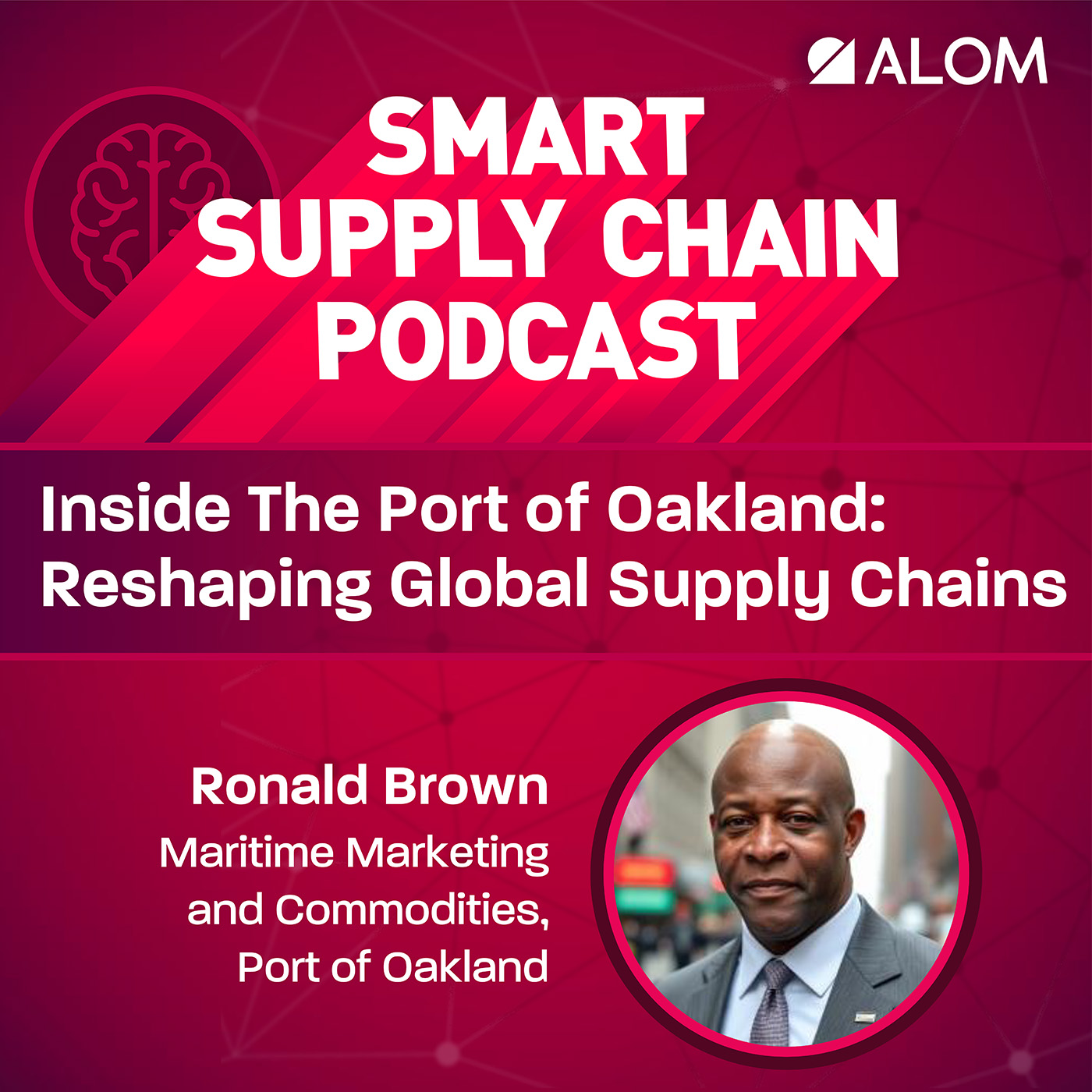
Welcome to the show, everybody. Today we are going to talk about the role of ports and global trade and we’re also going to find out specifically how the Port of Oakland is embracing technology and sustainability initiatives. To walk us through what’s happening today, we are thrilled to be joined by Ron Brown. Ron is an international business professional with experience in a lot of different areas, marketing, finance, trade, supply chain, logistics. He knows it all. In 2004, he started with the Port of Oakland and his journey started with getting involved in a marketing campaign for international exporters and importers. But today he’s regularly meeting with a lot of different people on the US side and international side. So we want to hear all about it. Ron, welcome so much to the show.
Ron Brown
Well, thank you and I’m very happy to be here. Great introduction. It just means that I’m an old guy. I’ve been around a while, been around for a while.
Shireen
And you’ve got a lot of that just means more experience Ron. So tell us about your experience and what what is your role at the port and what do you do on a day-to-day basis?
Ron
Well, my title is Maritime Marketing and Commodities Rep Representative. But what that means is I pretty much interface with all of our stakeholders and it really is a broad audience. I mean, people think that it’s just, you know, the shippers themselves, whether they’re importers or exporters, and then the longshoremen. But there’s a whole audience of stakeholders that get your cargo from its origin to its destination, including truckers. Of course. You got the longshoremen. You have warehouse workers. You got customs workers. You have port employees. Of course in many cases you have third party logistics firms, like ALOM that actually coordinate the movement or the logistics of the movement of the cargo. So there’s a large audience of stakeholders that really move a product from its origin to its destination, an international product.
So I interface with them, but because I have been around a while at the Port of Oakland, I’m kind of the person that mostly handles agriculture, which is a a big commodity item for our port.
Shireen
How did you get interested in this line of work? What attracted you to this career path?
Ron
Well, since I’m talking with friends, I will share my secret. I actually fell in love with what I did. I have a pretty long career, started as a chemical engineer, got into technical marketing for large oil companies, moved to the Bay Area working for their for PG&E in marketing and market research, and then got asked to be a consultant to the base closure commission. For those of you that live in the San Francisco Bay Area, you remember that there was once upon a time a very large military presence and the bases were closed back in the early 1990s. So I was in asked to be a consultant to the Base Closure Commission, which helped transition a lot of that military property to commercial use. So one of the things that I was I was successful that is helping them convert a lot of it to the Port of Oakland for maritime operations.
But there were a number of bases in the Bay Area that were affected. The Presidio in San Francisco many people are aware of in Naval Air Station in Alameda. For those that remember the F14’s flying around in the Bay Area all the time, they came out of Alameda. So my role was primarily to help transition that military property to commercial use. In the process of converting a lot of it to the port, the Port of Oakland, I got to know a lot of the port staff and then the executive director then at the port offered me the position to come help sort of revamp the port for its new direction. And I, I took the position and looked at where I could best be effective and helpful. And I knew that Oakland being by proximity a port that handle a lot of agriculture kind of self-appointed myself as the person to help interface between the agriculture sector and the port. So that’s primarily what I’ve been doing for the last 22 years here at the Port of Oakland is really working with primarily exporters. But I do work with a number of importers and, and different stakeholders in the, in the maritime industry.
Shireen
You mentioned that you love it. Tell us what you love. Is this a fun role? Do you get to have fun at work?
Ron
Well, as you 2 ladies know, in our process of putting this together this morning, I had some fun and putting getting this to actually work on our end. So I really get an opportunity to meet a lot of great people all around the world and finding out more about their businesses, their culture, you know, what brings them together, how to be somewhat of a international matchmaker of products and services. So really get a great opportunity of meeting a real diversity of people. And, and, and is, is more importantly pointed out to me that we are one world. We all have similar interests no matter where we’re located, and that really helps stimulate me to stay in this industry. And, you know, when things kind of go awry and I can help, you know, help solve some of those issues, I certainly am happy to do it. So that’s really what keeps me stimulated on a day by day basis to be able to help people, you know, operate efficiently in their businesses internationally.
Sarah
That’s excellent. And we love talking to people who love their jobs. Ron, thank you so much.
Ron
Policy won’t give me a raise.
Sarah
Thank you so much for being here. We really appreciate it. We want to talk a little bit about the Port of Oakland’s role in global trade and maybe you could describe for us a little bit about what the Port’s importance is within the US and within the global supply chain.
Ron
Well, Oakland is sort of in a unique position being that we are on the Pacific. The the Trans Pacific trade between Asia Pacific countries and the US typically goes through the West Coast gateways and the primary ones are the Port of Los Angeles, Port of Long Beach. Then you got the ports in the Pacific Northwest in Seattle and Tacoma and Oakland ironically is right in the middle in terms of geographically and from a market share perspective, we’re right in the middle. But we’re also an essential port for really one of the largest population bases in the United States being in California. Now for those of us that are California residents, we know that there are 40 million people there abouts residents in the state of California. About 25 million of those are in Southern California and 14 million are in in Northern California. So if you look at just the Northern California population base, it’s bigger than most states in the United States. So there is a huge consumer demand for all types of products coming from Asia Pacific countries. A lot of that is furniture, consumer electronics, apparel, footwear, things of that nature that are produced in countries like China and Japan, South Korea, Vietnam and and other Southeast Asia countries.
So Oakland historically has been primarily an export port. We are the oldest on the West Coast in terms of, you know, when we were established. You know, for those of you that are old enough to remember the stories of the Trans Pacific Railroad, Oakland was the West Coast terminus for the Trans Pacific Railroad, primarily as California was developing as a state. Gold was discovered in 1848. I know that because I’m a San Francisco 49er fan. So the 49er piece of the course sticks to me. Materials and vessels that were coming into the San Francisco Bay Area, a lot of the rail components of the that equipment was coming in through Oakland and then put on ferry. So not to give everyone a history lesson, but Oakland essentially has been significant on the import side for equipment. I tell people all the time as I do presentations with visitors from around the world that we are the port for the Central Valley because of the agriculture that goes through our port. The Central Valley of California is the largest agriculture growing region in the United States and a lot of those products are exported through our port. We are the port for the Napa Valley. I mean those of you that are connoisseurs of great wines, there are a lot of great wines produced in the Napa Valley and now many of the other valleys along the the West Coast, Sonoma Valley and Salinas Valley. A lot of those are claiming to be great wine producing areas also. So a lot of wine and spirits are exported through our port and also Silicon Valley. Our port played an important role for the early development of hardware. I mean, not everything was in the cloud 20 years ago. You know, we had chips being made, we had large pieces of equipment that were brought in to to manage silicon into chips. So again, a lot of that equipment came through our port. So companies, and I don’t mean to do any name dropping, but companies like Facebook and Salesforce and others that have these large server farms, a lot of that server equipment still comes through our port. So again, you know, it’s sort of a play on words, but we are the port for Silicon Valley, the port for Napa Valley and the port for the Central Valley. So, but a big portion of our, our, our role is as an export port for agriculture products, some of which are refrigerated products, beef, pork and poultry, we call it proteins or exported through our port to other parts of the world.
Sarah
OK. So you’ve mentioned agriculture tech, beverages, those the primary exports going out of Oakland.
Ron
They are, they are some of the others believe it or not are recycled materials. You know, again, Oakland historically has been a last port of call on the US West Coast. So a lot of the recycled plastic and paper, we’re now even seeing glass as a recyclable and scrap metal goes through our port going to Asia Pacific countries, being reprocessed into things that we purchase, whether it’s refrigerators or cars or parts or what have you. A lot of those items are recycled materials that are exporting through our port and coming back as a, as a finished product in a, a, a different life, if you want to call it that.
Sarah
Oh, that’s interesting. So, OK, we all know that the global events, global trends that are happening are impacting ports. We know that. But tell us, how are these things that are occurring globally impacting Oakland port specifically?
Ron
Well, I mean, we feel some of the same indigestion, that’s a great word, indigestion that some of the other ports experience, particularly as it relates to things, some of the geopolitical issues. Tariffs of course created a a real concern for a lot of shippers, importers and exporters. You know, we saw a fluctuation in cargo movements as many of our importers were trying to get ahead of the tariffs. So they advanced what typically would be sort of seasonal cargo. They advanced to be ahead of that, that tariff so that they didn’t have to to pay that, that larger fee. So we saw a spike in volume and then after that spike in the warehouses and distribution centers were full and then we saw sort of a lull. So it changed for us, not only us but all the other ports, whether it’s East Coast or West Coast, we historically have operated with having sort of seasonality in the cargo that comes through our respective ports with the tariffs and with some of the other geopolitical events that have gone on or are still going on around the world, it really is causing how shippers handle their cargo, where they originate the cargo from. Many of them are now diversifying their cargo mix so that they don’t depend so solely on one geographical origin, which is creating routing changes for the ocean carriers, which means vessel schedules are are being affected. So we’re all having to adjust to that. So the geopolitical events and then some of the unexpected events like COVID really have affected how we operate and really has forced us to be a lot more flexible in our operations.
Sarah
Yeah.
OK. So you brought up COVID. Let’s understand more about what lessons you might have learned in COVID. What what have you learned and what have you guys adopted or doing differently now because of it?
Ron
Well, for us and I think for for many of the other West Coast ports, you know, the the claim was that COVID created a problem. My opinion and my opinion only is that it really didn’t create a problem. It exposed a a deficiency that we had. And I’m gonna give us some numbers and they’re not exact, but just just to round them off. If you look at the five large container ports on the West Coast, I mentioned Los Angeles, Long Beach in Southern California, then Seattle and Tacoma in the Pacific Northwest, and Oakland. Together we handle about, let’s call it 20 million TEU’s. For those of you in the industry, I probably don’t have to define what a TEU is, but 20 foot equivalent unit over 20 foot container. So let’s say it’s 20 million TEUs. If we grow at double digits, let’s say 10%, that’s another 2 million TEUs of incremental growth. Where does that cargo go? OK, where does that additional 2 million TEUs go on the West Coast? And let’s say you get multiple years of double digit growth, you know, in the second year you’ve got 4 million TEUs of increased cargo. Where do you handle that? Where do you process that? And what COVID did it consolidated that. In other words, we saw a lull, a tremendous lull when there was a almost no cargo move and many of us were seeing vessels on the West Coast. And I think the the news media had over 100 container vessels in San Pedro Bay at one point just sitting idle. All of a sudden that cargo began to be unloaded and then processed. And then following that we saw double digit growth. So where does that incremental growth go? So what COVID did for us, it exposed the vulnerability of of if we saw accelerated growth, we would have to adjust pretty aggressively to to handle that. It did create some problems. A lot of cargo was delayed because the terminals had to store that cargo somewhere, in some cases in in areas that were inaccessible for the importers to pick up. The other issue was with COVID, a number of facilities were shut down. They were deemed to be non-essential. So many of the warehouses that didn’t process foodstuffs, they were deemed to be inessential, but they had containers, they had chassis that were being sitting idle that were not being recycled or returned to the to the ports. And that in itself created even more congestion. So sort of jumping all over the place, but COVID exposed just sort of the vulnerabilities of the supply chain. If one part of it got disrupted, it pretty much disrupted the whole supply chain. Which forced us all to learn some very valuable lessons that we really need to communicate more broadly. We need to have better communication mechanisms amongst ourselves as ports and as other stakeholders. And we need to scenario plan for things like that to occur, whether it’s geopolitical events or in this particular case, it was a major catastrophe being COVID.
Shireen
It did. Do you think that so the port’s doing a lot of different things, but what what are companies that are using the port doing differently to reduce their risk? Do you see change in the way that the people that you’re engaging with are using the port?
Ron
Yeah. And the good thing is that they call it caused everyone to communicate as to what they’re either the pain that they were suffering or I knew in my particular case, I was getting lots of phone calls. I missed a lot of sleep during that period. Trying to help people find where their cargo was and when they might be able to have access to it or what have you. But to answer your question more specifically, it caused a number of companies to start diversifying their supplies. You know, instead of all of it coming out of China, they diversified some of the imports from Vietnam or South Korea or Southeast Asia. Some of it was being onshored. We’re seeing in some cases, you know, people finding supplies onshore from our neighbors to the north and south being Canada and Mexico. So it really caused people to diversify, you know, the sources of some of the projects. In some cases, they couldn’t diversify because of the uniqueness of that that commodity. But to the extent that they could diversify either the ocean carriers or their truckers or whomever, it really forced a lot of companies to sort of broaden the possibilities of how they were handling their supply chains.
Shireen
I mean, these are all great suggestions in terms of just building strong partnerships with your supply chain partners, having good communication and of course, visibility is call Ron, ask where my stuff is. I guess that’s the answer.
Ron
You know before COVID I had hair guys. I had hair!
Shireen
Well, Ron, these are these are good ideas. We’re just going to take a quick break. Thank you so much for tuning into Smart Supply Chain. Our podcast is for supply chain professionals who think and work smarter. We hope that you’re enjoying this discussion with Ron Brown so far. If you are enjoying the insights that we’re sharing, we encourage you to visit ALOM.com. That’s A-L-O-M.com and we have a lot of resources there, podcast information, blogs, white papers, and also if you want to follow our our podcast, you can do that or you can leave us a review. We also would love to hear from you and hear what topics you’d like to talk about in the future. Now let’s get back to our discussion with Ron Brown. Sarah, I think you want to talk a little technology with Ron.
Sarah
Yeah, let’s talk technology and innovation. I’m interested in understanding what technologies are having the biggest impact on port operations?
Ron
Well, we were talking previously about COVID. One of the good things that came out of it for ports, particularly those on the West Coast and might be some of the ports on the East Coast, although they are competition sometimes, but the the fact that technology played a very important role of getting information to people quickly. For most of us, we saw new technologies just develop overnight like Zoom and Microsoft Teams and others, so that we could communicate with people without having to be face to face with them. You know, being COVID, we couldn’t go out and we had to stay 6 feet from each other, wear a mask and all those things that you all may remember. The ports were able to get funding from many of us at the state level. The state of California funded significant portions of funding to help us improve our technology, and the federal government provided funding to really make sure that supply chains were visible. People could see what was going on, they could communicate about cargo movements. So we were able to get a number of grants to help us build out our technology. For those that do want to visit our website, you’ll see we now have our Oakland portal which gives people access to our terminals to see what our terminal turn times are. And what that is, is the amount of time it takes a trucker once they enter the terminal. We call it the, the, the portal, input portal and, and the amount of time they’re on the terminal. And then when they leave the terminal, we, and there’s a train going by. We working with our stakeholders, came up with a goal of 90 minutes for a dual transaction. In other words, for a trucker that’s entering one of our terminals, if he’s coming in with a loaded cargo or export, he drops that off and then he’d say picks up an empty to go back. That would be considered a dual transaction. So we established a goal of 90 minutes, but now we’re able to track that and not only track it, but also report it so that consumers, the truckers, anyone in the industry can look and see how our terminals are operating. We also have live camera feeds so that they can actually see what’s going on on the roads, whether there’s a long backlog of trucks waiting to get into the terminal, which would be street time or street time on before entering the terminal. So we’ve been able to provide a lot of information to truckers and to shippers so that they can plan their cargo movements. We also have implemented appointment systems and all this requires a lot of technology to provide to truckers and to shippers to make sure that they can schedule to come into the terminal at a certain time and makes their their, their transaction more efficient. So a lot of those types of technology, communication technologies came about as a result of COVID and more security. You know, as you would imagine, security is a big, big component of what we do. So we were able to reinforce many of our security measures as a result of that funding.
Sarah
Yeah, that predictability and visibility that’s so important in 90 minutes, that’s impressive. What role does automation play in that? Do you have a lot of automation happening on the port?
Ron
Well, I’m going to be very careful in my conversations because our friends and the labor unions who actually are and I and I want to back up and say to everyone, if you see a longshoreman, you should give him a hug. Because they really, the longshoremen and the truckers are the ones that really got us through this pandemic. And a lot of times we take for granted the role that they play. But for our port, automation could mean a variety of different things. You know, we do have a level of automation which is when the trucks enter the terminals, there is optical character recognition that takes information off the container. We can get information off the truck. We can get the driver’s information from their TWIC card or from the driver’s license. That allows the transaction to be processed a lot smoother for the trucker to get the information as to where he needs to go on the terminal to either drop the container or pick up an empty container. Some people see automation as autonomous equipment. In other words, autonomous cranes that load or unload the the the ships or autonomous yard equipment that moves around the yard. So automation can play a variety of different roles and and different types of port configurations. There is automated terminals at ports down in Southern California. Of course, there’s a number of them in Asia and in Europe. In terms of the fully automated model that most people think about, you know, remote operator or completely autonomous cranes, we probably won’t see that at the Port of Oakland because we are a smaller port in terms of geography. And to put in that type of automation for us would mean to cease operations for, you know, pretty significant period of time which would be disruptive to the whole supply chain. But in terms of other levels of automation, AI information sharing, the automated information that’s shared as trucks enter the terminal or leave the terminal, and the information is shared amongst of the longshoremen and the truckers, a lot of that is automated, but it’s not the remote or robotic automation that most people think about. So we won’t see that in Oakland for at least my career. I don’t know what will happen after that. But as you might see in a port like Rotterdam where they do have automated cranes and things of that nature, we probably won’t have that.
Sarah
Yeah. OK. So it I think this is the longest conversation we’ve had recently without mention of AI. So congratulations!
Ron
Well, you know, AI is a very interesting concept because, you know, you have people that resist it, or at least they think that they resist it. But if you have a cell phone, you have AI. If you drive a automobile that is 2000, 2012 or or a later model, you have AI, you have you, you’re pretty much driving your computer. And for those of us that don’t have hair and have been around a long time, you know, I always give sort of an example and it makes people laugh. I mean, just imagine what life was like when you actually had to stop and go into a phone booth and put in a quarter and call someone. Imagine what that was like. For Superman even had to stop at a phone booth to change his clothes. So AI is not going to hurt. It’s going to help in a lot of ways. And I think some of the ways that the maritime industry is going to be able to use it is it’s going to make us a lot more efficient at communicating the documentation that’s required to legalize the transaction to move a a item externally from abroad to the United States. There’s a lot of physical documentation, and you guys probably already know this, that is required in order for that product to be to legally be able to enter the United States. I mean, there are people that still use binders of documentation. And there used to be you had to deliver, you know, the document to a freight forwarder or a customs broker to get a signature. So AI is going to make a lot of all of that very efficient. It’s certainly, it’s going to make things more visible in terms of being able to see the transaction as it’s taking place. So I don’t think it’s something to be afraid of. I think we need to be able to to use it effectively. And we are beginning to see it happen. But AI is already here. For those of us that think that they’re going to resist it, it’s, it’s on your cell phone, it’s in your car, your TV is probably watching you more than you’re watching it. So AI is already amongst us.
Sarah
Yeah, exactly. I mean, if we can eliminate some of the non value added activities and that just freeze up the band with the focus on more important things like sustainability. Let’s move on to sustainability. I’ll turn it over to Shireen.
Shireen
Yeah. I mean, this is a major topic across all industries, across logistics, etcetera on sustainability. And I’m curious, are there initiatives that the port is doing to focus on sustainability or zero emissions?
Ron
Well, that’s something that we actually brag a lot about because we were one of the first ports to really look at the impact of our operations on our neighboring communities. We are as a Port Authority very in very close proximity to, as I mentioned, a pretty large population base here in Oakland, but also could have an impact on San Francisco, which many people know is a tourist destination for people coming from all over the world. So our operations could have a negative impact and we knew that. So we started as early as I remember 2004, 2005 really looking at how our operation could impact the community and looking at ways to reduce any negative impact of our operation. Imagine this as a port, we have about 8000 truck moves every day, OK. And many of those historically have been diesel engines. And for those that know what a diesel engine does, I mean it pretty much spews a lot of diesel particulate matter or historically it has. You look at ports like Los Angeles and Long Beach, the two of them combined handle about 35 thousand truck moves every day. So the potential for impact to neighboring communities in the whole region certainly is there. So we started looking at how do we reduce our impact. A couple of things that we did, we started looking and exploring shore power. In other words, for the vessels when they come into our port to turn their engines off, they’re not burning bunker fuel or even clean diesel. They’re able to use electricity. So they’re plugging in and powering their operations by shore power. We’ve been working with the other ports in our state and our governor who is imposed a very, have to take a breath on this one, a an aggressive zero emissions requirement for our operations. So we’ve been looking at things like electric vehicles, electric trucks, electric operations for all of our yard equipment and yard cranes. Electrifying many of our operations in order to achieve zero emissions. Now we’re all under a mandate of zero emissions by 2030. So we’ve been exploring a lot of technologies, electric vehicles, hydrogen fuel cell vehicles. Oakland has the very first commercially available hydrogen fuel station in the world at our port. So we do have heavy equipment, heavy trucks that are coming in being fueled by hydrogen. So many of those things are going on.
Personally, I’ve learned a lot about this, this whole process that, you know, we’re even able to achieve a level of reduction by the type of planning that we do around the port area. There’s certain plants that actually absorb a lot of carbon. We’re able to plant some of those in different areas around our port because they do absorb the the carbon emissions that that are provided by the trucks. So there’s a lot of things that are going on. We’re working with our state, our region, our city, and our communities to make sure that we’re communicating what we’re doing and finding out more about what their needs are.
Shireen
Yeah, it was. It’s a real balance between operational efficiency and also being a good environmental steward. I like the fact that you guys are planting some plants as well. It’s not only helpful from a carbon footprint perspective, but it’s also attractive, right? Makes the makes everything look nice when you go to work, I guess.
Ron
Well, it’s good. The plants seem to be part of the job. I mean, they’re, they’re, they’re, they’re like a level of employees. They’re doing their job by helping to reduce the amount of carbon that’s that’s in the air as a result of any of the operations that that we might have.
Shireen
Are your customers asking for sustainability and emissions types of things that they need help with when coming to the port? Is there are you hearing things from customers in terms of the zero emissions?
Ron
We are. Many of them, you know, they like to be able to with their products and their consumers to be able to say they’re doing sustainable projects, very environmentally friendly programs that they’re implementing. So yes, they’re, they’re a part of, we have a number of stakeholder and community groups that we’re communicating on a regular basis to report out to them, you know, what our accomplishments have been and finding out from them what more they need to hear from us and for us to to do to be able to support them. Think of it this way. I mean, we all work in the port area. We all breathe the same air. So we want to make sure that, you know, the water is clean, the air is clean and that we’re able to perform our duties in a healthy, friendly, safe environment. So as I mentioned, we are very close to many residential communities. So we certainly want to make sure that our operations are are being managed in a very efficient and, and safe way for these communities.
Shireen
I mean, it’s, it’s a monumental task and it’s very, very impressive what the Port of Oakland is doing in this space to keep it moving forward and try to meet that 2030 date.
Sarah
Yeah, thank you for what you’re doing. It’s important for the communities, but also for your workforce, which is what I’d like to talk about next, because I’m sure that talent attraction and retention is important for you guys. Tell tell me a little bit about how you guys are thinking about this in terms of the port specifically and just the industry in general.
Ron
Well, let me start with the industry because we are somewhat in an aging industry. Many of our stakeholders, whether they are truckers or ILWU, the I, let me not use an acronym, International Longshore and Warehouse Workers Union. These are the the longshoremen. Many of us are are aging and aging out. So that is becoming an issue that, you know, the availability of skilled laborers that you know the job, have been doing the job. You know, many of us are beginning to look at retirement and are retiring. So that certainly is becoming an issue. The other issue for us in the region that we’re in is somewhat of a challenge because we’re in a high tech region and to be able to find engineers and you know, scientists, computer scientists, we’re having to compete with some of the biggest corporations in America. I mean all the brand name technology companies are right here almost next door in some cases. So we’re having to compete with them for for talent. So it is it is a bit of a challenge to me. We do offer some great benefits. The port as a entity is a service provider. We are a quasi governmental agency, which means that we don’t as a agency generate any tax revenue. All of our revenues come as a result of our leases and our our operations and all the funding has to go back into the port. But we are able to be competitive to hire engineers, but people should understand that a port is more than just the truckers and the longshoremen. We have lawyers, we have engineers, we have finance professionals, we have accountants, we have marketing people. We have all types of skills that we we need and we’re constantly looking, looking for. We have a a very unique industry being that some of these skills can be transferable from other industries or other ports. From time to time we try to steal some smart people from some of our competitors and they try to do the same from us. And many people that learn the, the jargon in this industry and then you guys know, there’s a lot of acronyms. You could almost have a whole conversation without using a complete word. But we try to get people that understand the not the in the industry, the terminology and industry and how, how it works. So they answer your question more succinctly. It is, it is challenging. We try to be competitive salary wise and with opportunity wise. I mean, to give people an environment that they enjoy coming to work, they enjoy doing what they do.
Sarah
Yeah. It sounds like you’re facing what a lot of supply chain industries are facing like this need for the more mature, more experienced resources. And then I assume you’re also trying to attract younger talent into the industry. Tell us about that. What are you guys doing to attract?
Ron
Well, we are well and as a matter of fact, we’re currently engaged with a program that we’ve had in place for a number of years and that is bringing in paid interns that learn our operation. Oakland is a little bit different than LA and Long Beach in a couple regards as I mentioned earlier. But not only do we manage the seaport, but we also manage the Oakland International Airport. So a lot of our students and interns that come in get a full diversity of transportation experience, learning about the seaport, learning about the airport. We also manage a large portfolio of commercial real estate between the seaport and the airport, which makes up about 20 miles. So they’re able to learn a lot about sort of a quasi governmental agency, whether interest is on the aviation side, they get certainly a lot of information. And we also in close proximity to Cal Maritime here, which graduates some very, very good candidates, some of which have become full time employees at the port and many of which are a part of our intern pool this year. So we do bring interns in every summer. We do pay them pretty competitively and we put them to work. So it’s not a just come sit down and watch. It’s come sit down, watch a little bit and help and bring, you know, many of those young people skills that some of us older workers are slow to adopt, but need to so it is a good, good process of bringing in new interns and and we do compete with the other. You know, as I mentioned, being an area where high technology is, we do compete with the, the technology firms to bring in and good talented people.
Shireen
I, I love that you guys have a great internship program. That’s amazing. We love our interns at ALOM as well. It’s great, great to have people coming in and sharing their insights on things and getting fresh perspectives on stuff and also setting up people for success in their career going forward by being able to see something. Do I really want to go into this? Like I think it’s a, a great opportunity and,
Ron
And we do learn from them. So it’s, it’s a two way relationship.
Shireen
Absolutely. We, I learned a lot from our interns as well. Well, that’s all really great advice. Ron, we do have time for one final question. It’s a very important question. It’s very critical and we want to hear from you. What has been one of your favorite vacations or do you have a dream destination that you haven’t been to yet that you’re going to plan to go to?
Ron
Well, that is a great question. Well, fortunately for me, I, I do, I am one of the people at our port that actually hosts a number of the international delegations. So I do get a lot of visitors from other parts of the world. And they’re always here to, you know, certainly to learn from us and in some cases are here to, to, to meet new trading partners. But in some of them I’ve found places that I want to visit. So I’ll, I’ll share the most recent one with you, and I’ll share one of my long afflictions, we’ll call it that. I grew up older than you young ladies. I was a Humphrey Bogart fan, OK? One of Humphrey Bogart’s best movies was Casablanca, OK. And in this movie, he was Rick and he managed a bar in Casablanca. So the movie Casablanca is one of my favorite movies of all times because one of my favorite actors of all time. So one of my bucket list vacation spots is visiting Rick’s Cafe in Casablanca, Morocco to have a martini and to check that off of my bucket list. So that is, that is one of my one of my bucket list items. And ironically we’ve had some visitors just within the last couple of weeks from Morocco. They were visiting as a result of another friend of mine or an agency friend of mine, the Almond Board of California. So I’m going to give it a little bit of a advertisement for them. They, they invited one of their customer, international customers to visit the port. So I had a chance to meet with some delegates from Morocco and I share with them my interest of visiting Casablanca and going to Rick’s. And one of the people there had been there. OK, he’s from Casablanca and he had been to Rick’s because it is a tourist attraction, because there are other Bogey fans around the world. So the answer your question more succinctly, one of my bucket list items is to visit Rick’s Cafe, Casablanca, Morocco.
Shireen
That sounds like a good trip. I mean, you’ve and you’ve got friends to visit there now.
Ron
Yes, yes!
Shireen
I’d come and join you for your martini.
Ron
He has a martini waiting for me.
Shireen
Oh, that’s amazing.
I like it. This is a good way to meet, meet friends from across the world.
Ron
That’s why I love my job.
Shireen
It’s amazing. Ron, thank you so much for joining us today. We really appreciate your time and all of your insights. And we’re really excited actually to hear about some things that I didn’t know were happening at the Port of Oakland. So thank you so much for sharing that all with us. Thanks to everybody else for tuning into Smart Supply Chain wherever you enjoy your podcast or check us out anytime at ALOM.com. Ron, thank you so much.
Ron
Thank you.