[Shireen] Welcome to Smart Supply Chain. It’s a podcast for supply chain professionals who think and work smarter.
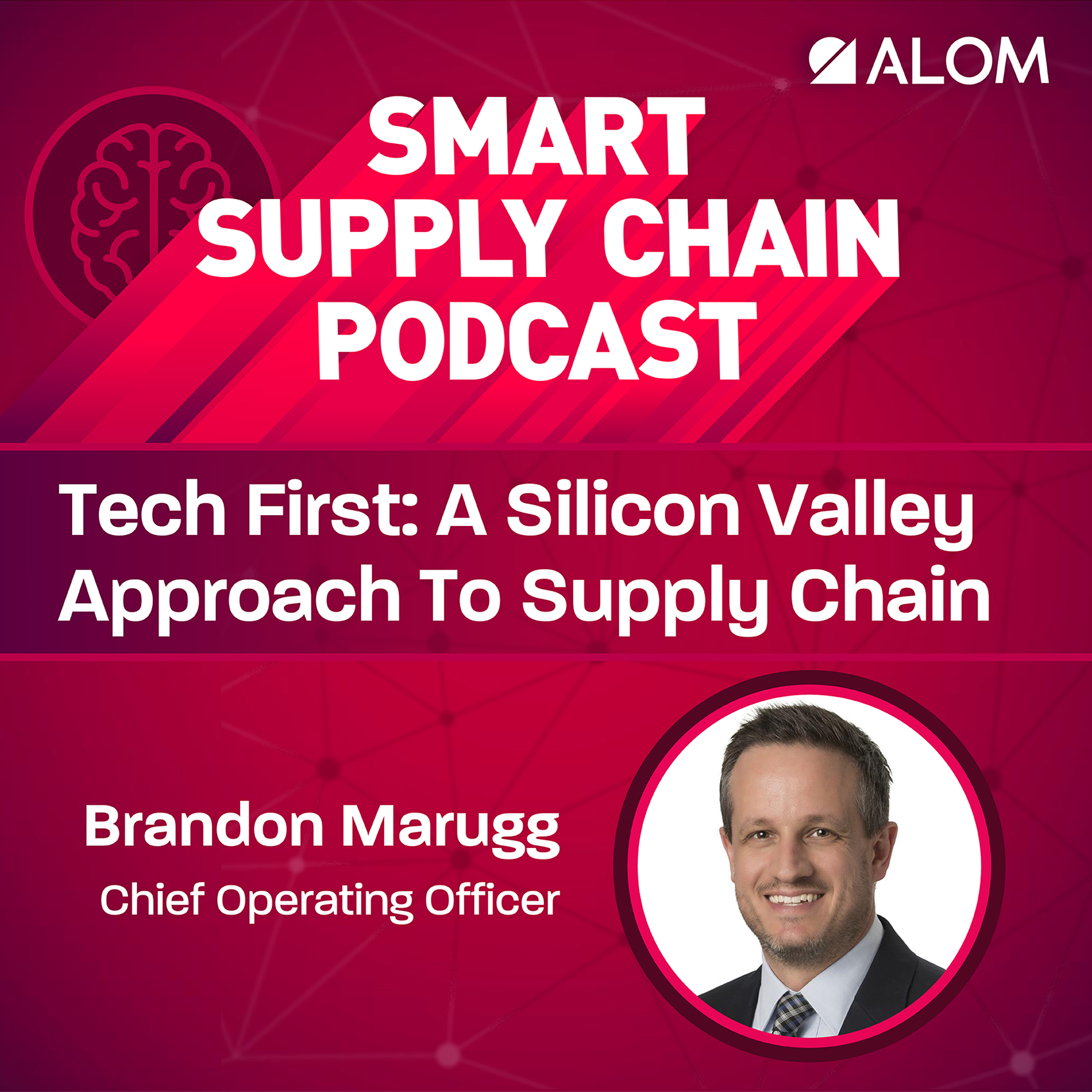
I’m your host, Shireen Garrison, and I am thrilled to be joined today by our very own Brandon Marugg. He is our Chief Operating Officer at ALOM. Welcome, Brandon.
[Brandon] Hey, it’s great to be here, Shireen.
I think it’s been a while since we’ve done one of these.
[Shireen] It has been a while. You know, I like to get you on as often as I can, but, you know, you’re so busy these days.
[Brandon] Yeah, Yeah, I know. I’m trying to be a podcast star at the same time. And it’s, it’s tough.
[Shireen] It’s I know you have a busy life that you can’t get that podcast to the top of your agenda list. I get it.
[Brandon] Well, I’m here now.
[Shireen] Well, good. Today I thought we could talk a little bit about ALOM’s journey. And for me, ALOM’s journey and your journey are very much connected because you’ve been with ALOM since the early 2000s and it’s been nearly 30 years since Hannah started ALOM. It started in 1997. So we really grew from like a pretty basic packaging and fulfillment company and really changed into much more of a supply chain strategic partner.
And I feel like a lot of that change was influenced by the area that we started in, which is in California, specifically the Bay Area. And it was really focused on innovation. And I think that has influenced the way that ALOM has kind of grown up and turned into a supply chain partner that is very much focused on technology and innovation.
And a lot of the clients that we’ve partnered with and specifically you as well, you grew up in the Bay Area. So you’ve seen a lot of changes and shifts over your whole growing up and going into ALOM in the early 2000s. So I’m just wondering how much of the evolution of the Bay Area and innovation and then specifically you being a part of growing into ALOM as well. How much do you think that is really influencing how ALOM operates today?
[Brandon] Yeah, I think it influences it tremendously even, you know, not even consciously, but I think to give credit where credit is due was very conscious decision by Hannah, Hannah Kain, CEO and founder back in 1997 that she opened in the Silicon Valley right at the kind of beginning of the web boom right in 1997. And, and she did that because she wanted to have a company that was focused on innovation, that put technology first, solved problems via engineering.
She wanted to find the smartest people that were available in the world. And she felt that the Silicon Valley made sense there. And you know, in, in those days, the Silicon Valley was growing up and becoming a hub of innovation as the Internet was, was, was exploding and, and Hannah really thought what we needed to, we need to put technology first.
It’s a lot of it, like a lot of these technology companies in the, in the Bay Area and Silicon Valley are dealing. So we were one of the first companies to have a, and what we called an extranet at the time or a customer portal on the web in 1998. That was pretty exotic.
She also made a conscious decision to make IT a strategic department and not a cost department. And frankly, that’s something that is still a little unusual today where most of a lot of our competitors will treat IT just like they would treat facilities, right. It’s an it’s a supporting department. It probably reports up into finance. It’s a cost center.
It’s keeping the lights on, right, but not at not at ALOM. And I decided very early on, in the in the late 90s that IT would report directly to her and that we would lead with, with technology.
So right, I came around in 2001 just to let you know a little bit about me.
So it’s 25 years this year coming up in, in August. And you know, there’s plenty of people in my organization that are, that were born after I started at ALOM, which is a sobering, sobering thing. I, I stopped counting that, you know, a couple of years ago when I first realized it.
[Shireen] You’re aging yourself here, Brandon, You’re aging yourself.
[Brandon] I know there’s a little there’s, I mean, you know, it’s not, I don’t look exactly the same as I started in in 2001,
[Shireen] But you started in 2001 and you were actually in IT then. And so you were really driving what the technology plan was for ALOM and helping that to grow.
[Brandon] Yeah, that’s right. You know, we weren’t a five person company. We also weren’t a 500 person company, right. We were still, but we are large enough that I probably shouldn’t have been reporting directly to the CEO as the leader of the technology organization back in 1997. But I did and I always have and yeah, so, you know, building the company from a technology first perspective has been obviously my entire career’s work essentially. And since I’ve been at ALOM and it’s, it’s been so much fun to build the company in, in the, in the Bay Area, having access to, you know, innovation and innovative people in the area.
And that bold technologies space right where we really look to, to technology first when they’re, when presented with a problem, rather than throwing people at it or spending money in some other way.
But how do we spend money correctly in the technology space to not only solve the problem, but solve it well, solve it with high, high level of quality and make it easy for people to perform well in the actual physical operation of that of that solution, right?
Because at the end of the day, for me, it was always about improving people’s lives and the quality would come and the, and the productivity would come kind of along free. And that’s something that we carry forward to today. And I think that’s another thing that’s very influenced by the Silicon Valley. The Silicon Valley has been in the business of trying to improve people’s lives, right. We can have a discussion how well they’ve done that over the past quarter century. But that’s certainly part of the culture of innovation is how do we improve people’s lives with technology.
[Shireen] How do you think that helps to set ALOM apart from other companies that are in the supply chain world?
[Brandon] Yeah, I think it comes in to with solutions, right. With the solutions that are sustainable, they’re scalable, they’re they become easy to maintain as we as we perform, as we perform whatever service it is that we’re doing for a particular customer.
You know, Fiona, our Chief Commercial Officer recently wrote an article about the operations that should be kind of silent. You know, if you if the customer is paying a lot of attention to your operation, then you probably are doing something wrong, right? We want to have elegant solutions that has high quality that allow our customers to do the thing they do really well and which could be product innovation or something like that, you know, designing the new product while not worrying about getting their existing product or their existing supply chain humming, right? That’s really what we’re for.
[Shireen] I mean, that’s a great point in that article with Fiona was really good just talking about how you shouldn’t be having your customers pay attention to what’s happening in your operations. If they are paying attention to that, it’s probably because something is going wrong. You need them to just trust you can get it done.
[Brandon] Yeah, exactly. The old easy button, right. That was that’s something that I think Hannah still says every now and then about what, you know, we want our customers to think of us as the easy button.
[Shireen] Absolutely. You know, one thing, I do feel like you helped to really influence how the culture has been set up at ALOM. And really this whole idea of innovation and technology I think got accelerated when you came into the company just because of, again, where you grew up. But also you’re kind of a giant geek in a lot of ways, Brandon. You’re into technology. You also, what did you go to school for? What was your what was your major? Yeah, astrophysics. How does astrophysics influence things?
[Brandon] Yeah, you know, it, it’s, I’m, I am a geek, especially when it comes to science and technology and really education as you know, that’s part of my training philosophy and leadership philosophy.
I probably would have been a teacher or maybe a professor if I’d gotten lucky with, if I hadn’t gone into the supply chain industry. So I really thrive on finding elegant solutions based on data without over engineering, right? Then you can engineer, you engineer your way into oblivion as I like to say. So you want to have pragmatic engineering that creates an elegant, simple solution that’s easy to understand, it’s easy to support and it’s easy to scale. And that’s, you know what? I feel like we’ve done really well at ALOM the past 25 years now and that and, and then I’m hoping that a lot of that came from me.
[Shireen] I think so. I mean, I think one of the things also that I like about, again, what I think that you bring to the company is the sense of curiosity and, you know, problem solving and being able to really look at some of the challenges that our clients have or that we have internally and you start asking questions and trying to get to the bottom of it. And again, figuring out something easy to solve that so that it’s easier for the team internally and it’s easier for our clients.
[Brandon] Yeah, for sure. You know, life. I think I’m certainly a lifelong learner. I which I take for granted, but I think that’s, you know, people ask me why I’ve been at ALOM for so long. And a lot of it is that I get to learn something new all the time because as we have new customers and new challenges inside of existing customers, we’re solving something new, right? We’re bringing to bear our expertise and our innovation to a new problem all the time.
And that keeps me interested, keeps me excited. And yeah, it’s fun. At the end of the day, it’s fun.
[Shireen] Well, you’ve worked with some really iconic Bay Area customers and clients since day one when you started. One of the clients that started I think in the late 90s before you before you came in, but was still a customer when you were joining in the early 2000s, was a well known tax software company whose name I won’t mention. But this was one of the first, you know, kind of big clients that ALOM had. How’s that relationship evolved over the years?
[Brandon] They’re still a client of ours. I think we started with doing just flash memory or no, sorry, even before that. They’re talking floppy disk, floppy disk for a minute. Yeah, floppy disk for a minute and then on to CD’s. So this was good. You know, our first foray with them was getting their product into the stores, right. The physicalness of the software product that was in a box with memory that you’d put in the slots on computers and ask your parents and they exploded in popularity because they were a very early adopter.
OK, let’s try to make this tax filing business a bit easier on people, right? Once again, let’s improve people’s lives with technology.
And they had to get it to market. And this was before the Internet could really support downloading it, obviously. So you wouldn’t, this is when you would walk into a store and go to a shelf and pick up the software and, and buy it and install it in your machine. And I remember we had trucks lined up, you know, in the months leading up to tax season to get the product out into the shelves. And I remember that was about one of the first big things I came in to help solve for was to really scale that operation because it had gone pretty crazy over the past couple of years in growth.
And we were, you know, trying to scale that operation before you before the technology was really ready to do so, right. So that was our first foray to modernizing fulfillment and things like that when it came to that customer. Yeah, it was fun experience of fun one to get my training wheels on for sure.
[Shireen] Another early win for you was Lexar.
[Brandon] That was actually the flash memory I was thinking about. And I think we got with them before they actually went public. And it probably grew quite a bit after we they came on as a customer. Is that right? Yeah, that’s right. They grew a ton as well. They became kind of the leader or one of the one of the few leaders in the camera memory space at that point at that time. Once again, ask your parents. There were cameras that had little memory slots that you needed memory for. And Lexar was, was huge in that space.
Then we were doing all their packaging and, and omnichannel fulfillment and we went through, you know, their IPO, their public offering. And that was, that was another challenge that we faced, right, because that was, we had the entire compliance issue around going public with very high, highly accurate inventory. Of course, the reporting of the on inventory over the past, you know, 12 or 18 months or whatever it was at that time to satisfy those requirements.
So getting through that kind of regulation, that was our first big foray that I at least that I was part of getting in into the regulatory space, right? When they went public in the early 2000s, they went public in 2004 or maybe 2005, I don’t remember, but one of the one of those two and it and they would had a really hard time doing it without us because we had their inventory on point and all the reporting that they needed once again via the extranet thing that that we that we had that we’re still a little bit foreign to people leading at that time. And they were able to get all the reporting that they that they needed to to satisfy the requirements and have a successful public offering.
[Shireen] Yeah, which is an amazing experience to go through. I mean, one of the experiences that I have certainly been a part of is the growth and the fascinating journey with 23andMe. It’s obviously a huge DNA company. And I think that you guys signed the contract with them in 2008, and right before they were, they were named, I think it was Invention of the Year by Time magazine. And they really grew up after that blew up.
And there was a lot of news stories about this new technology with, you know, DNA testing and that was one of our early customers talk about how that really, you know, influenced how we use that technology within ALOM and also, you know, supporting a client.
How did that kind of come together when their demand really grew overnight?
[Brandon] Yeah, a couple of stories there. I’ll start with the demand situation. I remember that very distinctly because all those, you know, they went from this kind of smaller niche company that maybe your friend next door might know to all of a sudden being referenced on Saturday Night Live. The Simpsons. And there was a whole South Park episode and on 60 minutes. But all of a sudden they just really took off. And I just said invention of the year and one year that I think that the year that they got all that attention, they beat their sales forecast in, in Q4 by 7X, which is, you know, I’m not not 7%, right, 700 percent! 7 times.
And, and we were able to, you know, meet that demand, not without some, not without some effort, of course, but we were able to scale the operation quickly. And I doubt that anybody on the receiving end of those kits even noticed that there was, you know an additional demand. It’s not like anybody I had to wait for weeks for a kit if they were still getting them the next day. So that was a huge effort to get that done. And that was a technology first solution there, right? It was a, it, we, we went from it, we changed the fulfillment model entirely over essentially a weekend to really accelerate their fulfilment speed and, and yeah, and we’re able to meet that demand. It was some late nights, it was, it was pretty crazy. And, and, and once again, very fun.
And you know, it’s the kind of thing where you run 3 shifts and, and you’re, and you’re buying, buying pizza parties and things like that. And the customer’s watching things via BI dashboards at an operation center because everybody’s just so excited about the amount of volume that’s really pumping through. And it happened so quickly that it was very little like robotic automation that we could do.
It was mainly about the systems and the system performance and the end of and the process. We had made some severe process changes so that we were essentially shipping by serial number rather than by pick. It was a, it was a, an innovative way of capturing both serial number very, very quickly and, and have a high output on each fulfillment line. So it was really, it was really cool. It was a, it was, it was fun to do and the customer of course was, was absolutely delighted that we were able to meet the demand. So that was huge. And what was the other question you had about 23amdMe?
[Shireen] Talk to me a little bit more about just the technology that, I mean, we’re putting in place. I mean, obviously a serialized product. You want to make sure that Shireen gets Shireen’s kit and Brandon gets Brandon’s kit, because I don’t want your DNA and you don’t want mine. We want to know about what our own DNA is. So that’s really critical.
[Brandon] And you know, obviously there was a lot of work that was put into that, you know, in addition to the operational team, right? I always tell prospective customers that have serialization, you know, really know what your serialization means to you and to your, and to your client and to your, your ultimate end user, right?
Is it, is it a life and death situation or is, or is it a warranty situation? Or is it, you know, something about lot control? And if it’s a life and death situation, which is, you know, not quite life and death, but it’s certainly, as you said, you don’t want to be, don’t want to screw up each other’s DNA or have access to each other’s DNA accidentally or make a wrong decision medically because of some mixed results. So that’s pretty close to life and death. And that’s where we really honed our serial control prowess there. You know we shipped and I don’t even know we must have, we probably shipped 2 or 3 million kits that quarter and we didn’t have one cross contamination situation happening. And that’s because we are building the quality into the process, right? We’re not, that’s not because somebody’s inspected at the end of the line going that’s Shireen’s serial number. Yeah, that’s right.
Now that’s not what’s happening is you’re doing multiple scans of the shipping label against serial number in sequence where you’re not getting to process the next sequence unless the first sequence is correct, right. Where you have an assembly, think of an assembly line where there’s a quality step built into each scan or each gate and it needs to pass those gates before it can get to the end of the line. It’s a great example of kind of that human and technology interaction where, you know, we put things into place so that. It’s not all just on a person, it’s not all on the technology. You’ve got a mix of both, right. Right, exactly, exactly.
And it’s still scalable, right? That’s the other thing that’s, that’s the, that’s a big deal there, right? You could easily say, you could easily envision, oh, OK, well, you want to ship that many units? Well, now it’s going to be 4 to 6 weeks and then so many places in order because we really got to make sure that that serial number is correct. So we found a really good niche there where we could bring scalability and productivity to a very highly regulated and controlled high quality serial serialization program there. And you know, we were able to really leverage that into the into life sciences and medical space, right.
[Shireen] And I think after, yeah, I think, you know, after we did 23andMe, we really decided to expand more into that medical space and start to look at what we wanted to do going forward. And I think that’s when you got the ISO 13485 certification. I think that happened right after the 23andMe sort of boom is when we were looking into that.
[Brandon] Yeah, Correct. Yeah, exactly. And we started realizing that this, there was a kind of a missing piece here in an industry where, you know, once again, the Silicon Valley roots of improving people’s lives with technology. Well, of course, these medical, the medical space is all about improving people’s lives. And what we, what we found was the medical space was very highly regulated, but that regulation came at an extreme supply chain cost from time to market, just pure cost of regulatory situations and processes being very cumbersome, right, to make sure that you’re staying regulated.
So what we saw was these medical companies that were or quasi medical companies like 23andMe that we’re trying to reach into the Silicon Valley innovation space, you know, but where they where they wanted to bring something to market quicker. That was not necessarily, you know, a heart transplant thing or, or something that would go into somebody’s body, but that still qualified as a medical device, still had all those regulatory
requirements from the FDA, from other regulatory bodies. And but they wanted to be able to move faster and have a had higher scale and a lower overall cost of supply chain ownership, right.
So bringing that innovation that we learned from 23andMe and from the technology area, technology companies in general, growing up in the Silicon Valley and having those customers, you know, with high innovation, high iteration, bringing those two things together so that we could so we could service these companies, these medical companies that were reaching over into the technology space and these technology companies are
reaching into the medical space. So think like fitness trackers and know the company that we had that that worked with. There was also a medical device that was an air filter, right? So a class 2, well, still a Class 2 medical device, but really a piece of technology that sits in somebody’s room and filters the air. So the cross section between these two things is, is a place where it really thrive.
[Shireen] And I think we were able to really investigate a lot of those companies and find future customers because we were digging into that a bit more. And we definitely learned a lot with, you know, the air filter and air filter company and other, you know, kind of medical device sort of customers that we’ve had over the time.
[Brandon] Yeah, absolutely, absolutely.
[Shireen] Well, Brandon, no supply chain podcast can go on without talking about AI because that’s all we talk about these days is what’s happening. I think the police come and they for sure, absolutely. I feel like somebody would come in and slap my hand and say something about AI because I don’t feel like I can get out of any conversation without talking about it at some point in time.
[Brandon] So we’re right in the middle of, I mean, AI has been around for a while, but I feel like it’s just starting to get to the point in the last couple of years where it’s really, really becoming a big thing across a lot of different companies and not just in niche markets. And certainly it’s huge in supply chain. I think, you know, we’re serving AI infrastructure customers and we’re also deploying AI internally and have been doing this for a while.
[Shireen] How do you think ALOM’s position to really take advantage of all the stuff that’s happening around AI today?
[Brandon] Yeah, in several ways, right. So one, it’s a whole new industry once again concentrated in the Bay Area that we can help support as an industry, right via the customer relationship, which we are doing right. There’s, we have several customers that are in this space that are that are looking to us to really help scale. So we have more than one customer that’s providing hardware to the data centers that are they’re driving AI. Some customers that are also in the design space. When I say design, I mean like silicon design that are driving GPU CPU design and that kind of thing. So it’s a whole other space where we can hopefully help the industry grow, survive, thrive and scale.
But then of course, there’s using AI as a tool once again to improve people’s lives, right? And both our company and, and of course, and for our customers. So bringing AI to bear on internally when it comes to code creation and integration is already something that we’re doing.
So this is think we did it had an interesting project recently. That’s a fun story which is about EDI integration. So there’s still a lot of customers out there that we that we get that are on a kind of old school EDI transmission. So, and if you’re on SAP and some versions of Oracle, so that’s kind of some of the choices that you get for integration, right as you’re sending, you’re sending over this at a fact integrate at a fact documents or other traditional EDI standards. And, and it’s getting, you know, less and less supported by modern systems. But we recently brought EDI, brought EDI into our anthropic deployment and create and integrate a new type of integration for those EDI documents that funnels through AI where AI is looking at the documentation for that EDI. Then it’s actually looking at the examples that are actually sent in the EDI to cut shocker of the EDI signal that comes over is not always what specs as it’s going to be and make and it’s making on the fly modifications or on the flight judgments about how to modify those documents to make them to spec and get them and get them integrated real time.
So kind of thing where you would normally use a value added network or an integrator or something like that is starting to replace that and accelerate it. So we were able to bring on an EDI trading partner without a van, without EDI specific software, just by using our, our Claude deployment to help facilitate the communication.
So I think about a pod, one of the podcasts that I did for ALOM, you know, maybe two years ago, I think about a year and a half ago on AI and I had predicted that AI would be brought to bear on old school IT integrations at some point. And here we are actually doing it now. And that’s something that’s really been possible, I would say over the past eight weeks, 12 weeks, certainly 2026, you know, that’s how fast it’s moving. That wouldn’t have worked in 2025 and that’s working kind of Florida state now.
[Shireen] And that’s pretty, pretty crazy, pretty exciting, pretty crazy. Any predictions that you want to give today or anything you think’s going to happen?
[Brandon] It’s here to stay, that’s for sure.
[Shireen] Yeah.
[Brandon] So I think about it too. It’s fun because the last big kind of thing that we had in the supply chain coming out of the Silicon Valley, that was, you know, a big deal was blockchain. And, and it’s probably been a while since anybody’s thought about blockchain outside of, outside of, you know, a few very large companies like IBM and of course, you know, the Bitcoin stuff, right, which is where it’s still used. And the problem that and blockchain fizzled out a little bit to go mainstream in the supply chain area, mainly because of the barrier to entry. You needed a lot of cooperation between all trading partners involved for blockchain to kind of work. And it was a pretty big investment for everybody. So it’s really hard for people to come along for the ride, right? And having a mom and pa, a mom and pa shop trucking company come along for the blockchain, right? It’s just a complete non starter.
But that is not the case with AI, right? AI for a couple hundred bucks a month, you’re, you can start playing around and doing real things. And so that’s, that’s a big difference between blockchain and AI. So it’s definitely here to stay. I think that we’ll have winners and losers like in every other, every other industry. And that’s still to be determined as none of these big, big guys have gone public as of taping. But when they do it’ll, yeah, it’ll, it’ll start to shake out a little bit more.
And, you know, supply chain companies aren’t going to be replaced by AI, but supply chain companies that don’t use AI will be replaced by supply chain companies that do. It’s yeah, it’s not a silver bullet for sure. But again, it just goes back to that kind of human and technology integration and, you know, interaction that there’s a lot of great things that AI can do, but it doesn’t completely replace the human judgment.
[Shireen] And you still need, you still need humans to make AI effective.
[Brandon] Yeah, that’s right. So the agentic stuff gets a little bit creepier, right? That’s so the agentic AI is when it’s taking action for you sometimes without asking and making decisions. And that’s our, you know, that’s really our showing up a lot these days and contract negotiations and data privacy agreements and, and those types of things where companies are starting to pay attention to, OK, who am I hiring here? Am I hiring a company where people are making decisions or am I hiring a company where a computer is making decisions? Right.
So, that’s certainly something that we are taking very seriously and have not started down that road yet of, of AI making decisions for us. We have a philosophy that AI can make recommendations, but it’s always a human, at least for now, that’s always a human making a decision.
[Shireen] Absolutely. Brandon, any, any last advice in terms of, you know, people working with, you know, companies in the Bay Area and our kind of culture of innovation? Any last words about innovation and supply chain?
[Brandon] I mean, you know, it’s, it’s, I think it’s never OK to sit pat with what you’re doing, right. It’s so one of our core tenets is continuous improvement. And for me, continuous improvement starts with innovation, especially with technology. And just because you know, if it’s not broke, don’t fix it. Not always the case. You know, it should be all you should always be looking at what your what your supply chain is doing, where it can be improved, where you’ve got risk and where that risk is changing as the world changes. I don’t know if you’ve noticed, but the world is a little volatile these days.
[Shireen] Really? OK, I’ll check my news feed.
[Brandon] Risk and opportunity profile is constantly changing. So it’s something you need to pay attention to all the time.
[Shireen] Absolutely. Well, you know, I always ask everybody on my podcast one last question. And my question is usually around travel. But because you are such a, you know, a little bit of a tech geek and a space geek, I am tweaking my question today to ask you if you had the opportunity to travel and take a holiday on Mars, would you do it?
[Brandon] Oh, man, that’s a tough one. In the current state, probably not. You know, Mars sounds like fun, but so think about Mars. A warm, pleasant day on Mars is like being in Antarctica except with no air.
[Shireen] You know, you have to have the right equipment. On any holiday, you always have to think about what you’re going to pack. OK, well, I’ll take that answer.
[Brandon] The moon sounds like more fun in a little bit, a little bit closer.
[Shireen] All right, so maybe you would have been one of those people that would have taken the trip to the moon.
[Brandon] Yeah. Artemis 2 that just went around fairly recently. That that was pretty cool. And look at looking forward to that, to the next missions for sure.
[Shireen] All right. Well, thanks, Brandon. That’ll have to be the last word because we’re out of time. But I would like to thank Brandon Marugg, our COO. And I really appreciate you being a guest here on Smart Supply Chain. And for everybody tuning in, we’ll catch you next time on Smart Supply Chain and you can check us out anytime at alom.com.
Thanks, Brandon.